Year 1Little STaRS and Decision Maker
Little STaRS
Topics and skills covered: medicines, feelings and friendship, people who help us stay healthy, risk, staying safe at home, computer safety.
- Helpful drugs are called medicines. We get these from the chemist, supermarket or doctor.
- Some medicines help us feel better, like Calpol (prescription meds), some medicines stop us getting poorly, like vaccines and asthma inhalers.
- Our parents, carers and guardians help us make sure we take the right amount.
- Treating others unkindly or saying unkind things can make others feel sad.
- Discuss the range of people who help keep us safe and healthy: parents, carers, family, emergency services, doctors and nurses, crossing patrol, teachers, teaching assistants.
- Some situations might be risky, we don’t know how things will turn out and there is a chance something might go wrong. Discuss situations involving risk, such as crossing a road, and what we do to reduce risk and keep safe.
- Some household products are stored in locked cupboards, under the sink or on high shelves because they can be harmful if misused.
- We need to stay safe when working or playing online and not respond to messages from people we don’t know. Be online in a room where there is an adult and ask them if you aren’t sure.
This guidance is designed to help you if your child is taking part in the Life Skills STaRS programme in Year 1 at school.
Decision Maker
Topics and skills covered: medicines, staying safe at home, computer safety, difference (gender and sex), staying safe outside (roads), empathy, choices, decision making, considering risk and feelings.
- Our parents, carers and guardians help us make sure we take the right amount of medicine.
- Problems with friends at school are best sorted at school with the teacher and friends involved.
- Boys and girls are equally fun to play with and all can have great ideas.
- Cooking at home should always be done with an adult.
- Never share your computer passwords, even with friends.
- Always wait for the green man sign before crossing the road, even if there’s nothing coming.
- Leaving people out can make them feel unhappy. How would you feel?
- If you find something that doesn’t belong to you, always give it to a trusted adult.
- Holding hands with an adult when walking along busy roads is always the safest option.
- We are all different in lots of ways. Making fun of someone because they’re different from you can make them feel unhappy.
This guidance is designed to help you if your child is undertaking the Life Skills Decision Maker programme in Year 1 at school.
Year 2Super STaRS and Decision Maker
Super STaRS
Topics and skills covered: medicines, feelings (stress and worry), people who help us and support networks, risk and consequences, staying safe at home (medicines), online safety.
- Think about things we put on and into our bodies, some protect us like sun cream, some keep us healthy like fruit and vegetables. Too much unhealthy food can be harmful.
- Some medicines help us feel better, some stop us getting poorly, like vaccines and asthma inhalers. These may be tablets, liquids or injections.
- All medicines should be stored safely and not shared with other people. Adults will help.
- It’s normal to worry about certain things. We all worry about different things and all feel differently when we are worried, such as butterflies in the stomach or getting sweaty or hot.
- Worry is sometimes called stress. Healthy ways to deal with worry include exercise, listening to music and, most importantly, talking to someone about it.
- Consider the range of people who help keep us safe and healthy: family, neighbours, emergency services.
- Risk is doing something and we don’t know how it will end. Consequence is the result of an action, which could be positive or negative.
- We need to stay safe when working or playing online and not give out any personal information, such as address, telephone number or school. The best way of dealing with a problem online is to tell a trusted adult.
This guidance is designed to help you if your child is taking part in the Life Skills STaRS programme in Year 2 at school.
Decision Maker
Topics and skills covered: medicines, staying safe at home, online safety, difference (gender and sex), staying safe outside (fireworks), empathy, goals, stress and worry, decision making, risk, bullying and health.
- Medicine brought to school should be given to the teacher, because of the risk to other children if it is lost or dropped.
- Correct stereotypes that boys are better at sport and girls are better at academic subjects. We are all different and unique.
- Plug sockets at home can be dangerous. Allow adults to plug things in and fit safety guards.
- Avoid entering your name and address when working online, even if something free is offered. The same applies if someone rings on the phone, pass the phone to an adult.
- Ask permission before taking a photograph and never share it without permission.
- Fireworks are exciting and fun but you have to be 18 to buy and use them. Always allow adults to deal with them.
- Rules are there for a reason, even if we don’t always agree with them or understand why.
- We must always think about how others are feeling when we work and play. This is called empathy.
This guidance is designed to help you if your child is undertaking the Life Skills Decision Maker programme in Year 2 at school.
Year 3Shooting STaRS and Decision Maker
Shooting STaRS
Topics and skills covered: medicines (allergies), friendship, vaping, difference and diversity, staying safe outside the home (road and water), managing and balancing time online.
- An allergy is when your body reacts to something which is normally harmless, like dust, pollen, food or animal hair.
- People may take medicines for allergies: mild ones such as inhalers and anti-histamines, severe ones such as EpiPens.
- We all need friends, they make us happy and feel safe. We can’t be friends with everyone but our actions affect how others feel.
- Sort drugs we’ve heard of into legal and illegal, helpful and harmful. Medicines are legal and helpful, some are age restricted, such as alcohol and caffeine in small quantities. Nicotine is legal at 18+ but harmful.
- Vapes or e-cigarettes were designed to help people give up smoking. They haven’t been around long enough to measure long term effects, and contain nicotine, which is highly addictive.
- Diversity means everyone is different. We are similar in lots of ways but different too, in size, gender, skin colour, interests, or where we were born. Treating someone unkindly because of a difference is wrong.
- What are the risks of going too close to water or a road, and what could you do to keep yourself safe? Follow pool rules, listen to the lifeguard, cross roads in safe places, stick with an adult.
- Agree a family limit of screen time per day. Recommended limits for 5 to 17 year olds are no more than two hours a day.
This guidance is designed to help you if your child is taking part in the Life Skills STaRS programme in Year 3 at school.
Decision Maker
Topics and skills covered: medicines, difference (gender, sex and race), vaping, staying safe outside (railway), staying safe at home, online safety, respect, communication, fact and opinion, options and consequences, rules, theft, bullying, pressure, friendships and health.
- Body language, like shrugging shoulders and rolling eyes, can send a message you don’t want to send.
- If you find medicines, hand them to an adult straight away.
- Whether you are a boy or a girl shouldn’t affect which job you can do when you are older.
- You may see empty vapes on the floor in the street. Leave them there and ask an adult to help. Vaping is only legal for over 18s.
- Railways can be a dangerous place. Lots of signs warn you of the dangers and fences keep you out. The law says don’t go near, and even at a station, stay behind the yellow line.
- If taking digital pictures and videos of yourself, keep them for you and your family to share, and don’t post on platforms like YouTube. Certain platforms have age restrictions.
This guidance is designed to help you if your child is undertaking the Life Skills Decision Maker programme in Year 3 at school.
Year 4Mega STaRS and Decision Maker
Mega STaRS
Topics and skills covered: medicines and healthy lifestyles, friendship (peer pressure), alcohol, staying safe outside the home (railway), sharing media online.
- A doctor may prescribe a medicine if we are ill, but we can do lots of things to help us stay healthy: a balanced diet, exercise, plenty of water, good sleep, friendships.
- Peer pressure is when someone roughly the same age as you encourages you to do something. This can be positive, like trying a new food, or negative, like encouraging you to be unkind to someone.
- What can you do if someone is pressuring you? Think about the risks and consequences, and whether you can make an excuse and leave.
- When you are 18 you’ll have the choice to drink alcohol or not. Safe amounts are okay but there are risks, and some people choose not to drink for health, taste or religious reasons.
- Habits are things we do regularly, sometimes without realising. Good habits, like eating a piece of fruit every day, can be healthy. Bad habits, like spending too much time gaming, can be unhealthy.
- When out and about, discuss the safety measures in place: road crossings, fences around railways, signage at the river bank, rules at the swimming pool.
- When online, avoid giving out personal information, even to people we know: address, telephone numbers, school, parents’ names and occupations.
This guidance is designed to help you if your child is taking part in the Life Skills STaRS programme in Year 4 at school.
Decision Maker
Topics and skills covered: alcohol, medicines, difference (gender, sex and religion), vaping, sharing media, staying safe outside (water), respect, pressure, communication, consequences, desirability, rules and health.
- Medicines prescribed should only be used by the person prescribed them, and the course should always be finished.
- Alcohol should only be sold to or used by over 18s. It is addictive, and can be harmful to young people whose bodies are still growing.
- We can talk to, play with and have parties with whoever we choose. Leaving people out because of a difference, such as gender, religion, nationality or disability, is unkind and can hurt others’ feelings.
- Avoid entering personal information when working online: name, address, passwords, school, or details about your family.
- Rivers and open water can be tempting, especially when it’s hot, but strong currents and cold water shock can make swimming in rivers difficult and dangerous.
- Cross roads where there are designated crossing points. Crossing busy roads to save time can be dangerous.
- Avoid joining a group in the park if someone is vaping, it reduces the pressure on you to join in.
This guidance is designed to help you if your child is undertaking the Life Skills Decision Maker programme in Year 4 at school.
Year 5Decision Maker and Web Warriors
Decision Maker
Topics and skills covered: alcohol, vaping, medicines, difference (gender, sex and disability), drugs, online safety, solvents, knives, respect, stress, peer pressure, theft, consequence, rules, the law, health.
- Not everything you hear online is true. Even the lyrics of some songs can contain hurtful, racist, illegal or untrue information.
- Drugs can be grouped as harmful and illegal, or helpful and legal, such as medicines taken in the right quantities.
- Alcohol should only be sold to or used by over 18s. It is addictive, has long term health effects, and can be harmful to young people who are still growing.
- We should treat everyone equally despite their differences, even when a difference isn’t obvious, such as a disability.
- Avoid commenting online about someone else. If it’s written down, it can be copied and forwarded even if you don’t want it to be.
- If you find anything on the floor that worries you, such as tablets, capsules, cylinders, needles or knives, tell an adult. For non-emergencies, contact the police on 101.
- Some household cleaning products contain solvents, which can be harmful. Look at the warning signs on the bottles and store them safely.
This guidance is designed to help you if your child is undertaking the Life Skills Decision Maker programme in Year 5 at school.
Web Warriors
An online safety resource. Topics and skills covered: spending time online, the risks involved, age restrictions, receiving messages from strangers, and getting help.
- Spending time online is not just when on a computer, but any device connected to the internet, including phones, tablets, laptops and games consoles. The risks are the same.
- Research age restrictions of apps your child wishes to use, for example WhatsApp (13+ with parental consent), TikTok (13+), Snapchat (13+), YouTube (13+), Instagram (13+).
- Treat strangers online as you would in real life. Avoid accepting invitations and having conversations, and do not give out personal information.
- Discuss options for dealing with a problem online: tell a trusted adult, block and report, use parental controls and review them regularly, take a break, or research it and ask others.
- Screen time guidance recommends one hour a day for children aged 2 to 5, and one to two hours for children aged 6 to 12.
- Whatever is written and posted online, once sent, can be reposted over and over again. You are no longer in control of it.
This guidance is designed to help you if your child is undertaking the Life Skills Web Warriors programme in Year 5 at school.
Also relevant to Year 5: topic guides
These one page guides cover specific topics in more depth and apply to both Year 5 and Year 6. Full detail is in the topic guides section below.
Year 6Decision Maker and Moving On
Decision Maker
Topics and skills covered: alcohol, vaping, difference (gender, sex and sexual orientation), drugs, solvents, psychoactive substances, online safety, knives, respect, rules, the law, bullying, theft, health, social pressure, media.
- Pictures and voice recordings should only be taken with people’s consent and not shared without permission. Once sent on, you lose control of it.
- Empty silver canisters, often found littering the floor, are used to contain laughing gas (nitrous oxide), an illegal psychoactive substance. If you find one, tell an adult.
- We can respect different cultures even if we don’t agree with them.
- To buy and use alcohol you need to be 18 or over. Consider the consequences if caught: health risks, disappointing your parents, feeling ill.
- We are all different: age, gender, religion, race, sexual orientation and more. None of these are a reason to be unkind to someone.
- Never accept strangers into online games. If someone claims to know you, check with a trusted person first.
- Make an excuse and leave if you discover you are in a group where people are doing risky or illegal things, such as smoking, vaping or carrying a knife.
- Household products such as glue, paint, aerosols and cleaning products can contain solvents, which can be very harmful if breathed in.
This guidance is designed to help you if your child is undertaking the Life Skills Decision Maker programme in Year 6 at school.
Moving On
Topics and skills covered: the challenges of moving on, recognising and dealing with stress, communication skills, recalling previous successful “first times”, differences, peer pressure, saying no.
- Any worry or concern about moving to secondary school is completely normal and will be shared by many others.
- Worry can be described as stress. Strategies to ease it a little include deep breathing, talking to an adult, listening to music or reading.
- We are all different, but we’ll find new friends at secondary who share our interests and personalities. You don’t need to change to fit in.
- Peer pressure is when someone around your age encourages you to do something. Think about what might happen if you agree, then decide.
- Always hang around with people you know and trust. Avoid dodgy people and places.
- Change the subject or say no with a reason, if asked to do something you know you shouldn’t. You can also make up an excuse and walk away.
- What things have you done for the first time that turned out well in the end? Starting primary school, first assembly, school play, residential…
- Concentrate on your communication when meeting new people: speak clearly, maintain eye contact, and be a good listener.
This guidance is designed to help you if your child is undertaking the Life Skills Moving On programme in Year 6 at school, supporting the transition from Year 6 to Year 7.
Also relevant to Year 6: topic guides
The same eight topic guides used in Year 5 apply here too. Full detail is in the topic guides section below.
Topic guidesThese eight guides go into more depth on a single topic. They apply to both Year 5 and Year 6.
Alcohol
Vaping
Drugs
Knife Awareness
Misogyny
Differences
Online Safety
Solvents
Alcohol
- In this country the legal age to buy alcohol is 18. At 18, everyone has the choice to drink alcohol or not (some religions may not allow this).
- Our bodies are still growing up to the age of 18, so alcohol could be harmful.
- Scientists and doctors think alcohol is safer in small amounts each week, 14 units, roughly 6 pints of average strength beer or 10 small glasses of lower strength wine.
- The size of the drink is not a good guide to the amount of alcohol in it. Shots and spirits can have as much or more alcohol than pints.
- Alcohol can be addictive, and mixing alcohol and drugs or medicines can be harmful and mean medicines don’t work.
- Avoid suggesting alcohol use is a cure for stress, there are healthier ways to deal with stress: reading, exercise, talking about it, relaxing.
- Avoid instilling fear. Drinking too much alcohol over a period of time can increase the risk of an alcohol related disease, but scare and shock tactics don’t always work.
What skills should you talk about as well? Children are best armed with accurate facts alongside strategies and skills to say no if they need to: dealing with stress and peer pressure, communicating clearly when saying no, the MATES resistance strategies, and considering risk and consequence within the SKILL decision making model.
Vaping
- In this country the legal age to buy a vape is 18.
- Vaping, like smoking, contains the drug nicotine, which is highly addictive. Vaping was invented to help adults stop smoking, and reduces the number of chemicals inhaled, but still contains nicotine.
- Scientists and doctors think vaping may be safer than smoking cigarettes, but there is no long term evidence yet. Safest to do neither.
- Flavoured vapes, such as strawberry or bubble gum, usually contain nicotine too. These flavours are designed to attract young people and get them addicted.
- Vaping is an expensive habit and a waste of money. Highlight what their money could be used for instead.
- The vast majority of young people do not vape. We tend to notice those who do, which makes it feel more common than it is.
What skills should you talk about as well? Dealing with stress and peer pressure, communicating clearly when saying no, the MATES resistance strategies, and considering risk and consequence within the SKILL decision making model.
Drugs
- Drugs can be arranged into two groups: legal and helpful, such as medicines, and illegal and harmful.
- Some legal drugs have age restrictions, alcohol and nicotine at 18. Legal drugs such as medicines can also be harmful if taken in the wrong quantities or by someone they were not prescribed for.
- Challenge 25 in shops checks anyone buying alcohol or nicotine who looks under 25, requiring ID to prove they are over 18.
- It is against the law to possess many illegal drugs. Never agree to hold or carry something for someone you don’t really know, or if you don’t know what it is.
- A criminal record relating to drugs possession can affect the job you get or the countries you are allowed to travel to.
- Avoid instilling fear about drugs. The vast majority of young people do not use drugs. Being informed about the risks and having the skills to step away is an effective way of staying safe.
What skills should you talk about as well? Dealing with stress and peer pressure, communicating clearly when saying no, the MATES resistance strategies, and considering risk and consequence within the SKILL decision making model.
Knife Awareness
- In this country it’s illegal to carry a knife in public without good reason. Carrying a knife to feel safe or for self defence is not a legal reason, and people who carry knives are far more likely to get hurt, often with their own knife.
- The police can stop and search anyone they believe is carrying a knife. Getting a criminal record can affect your ability to get certain jobs, and you can get into trouble by just being with someone who is carrying a knife.
- The legal age to buy a knife is 18. Sharp knives should be taken straight home and not removed from their packaging until safely inside.
- Some jobs and hobbies may involve using a knife. They must always be stored safely with other tools or equipment.
- The vast majority of young people do not carry knives. We often hear about incidents on the news, but no one reports the days when there have been none.
What skills should you talk about as well? Dealing with stress and peer pressure, communicating clearly when saying no, the MATES resistance strategies, and considering risk and consequence within the SKILL decision making model.
Misogyny
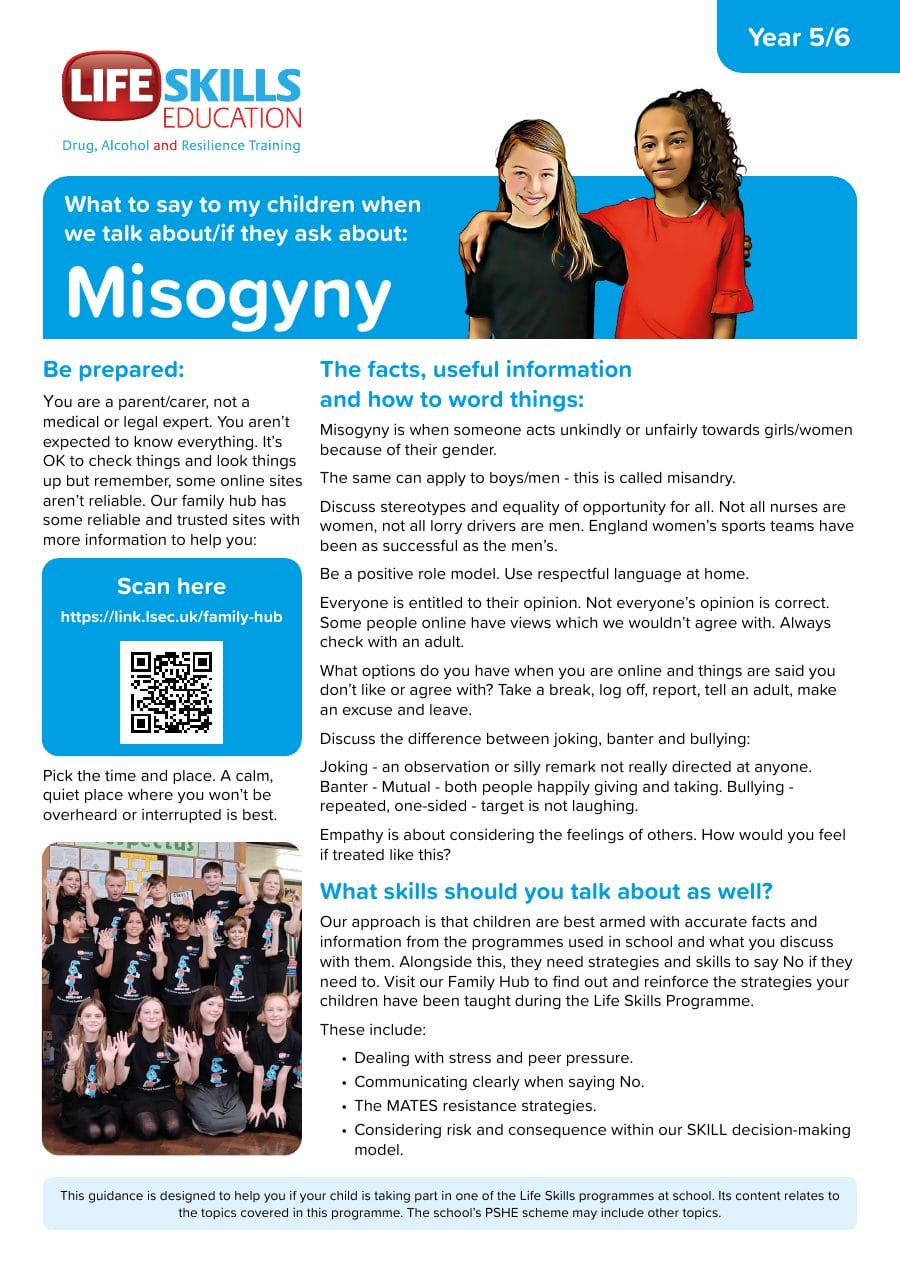
- Misogyny is when someone acts unkindly or unfairly towards girls or women because of their gender. The same applied to boys or men is called misandry.
- Discuss stereotypes and equality of opportunity for all. Not all nurses are women, not all lorry drivers are men, and England’s women’s sports teams have been as successful as the men’s.
- Be a positive role model and use respectful language at home.
- Everyone is entitled to their opinion, but not everyone’s opinion is correct. Some people online have views we wouldn’t agree with, always check with an adult.
- Discuss the difference between joking (a silly remark not really directed at anyone), banter (mutual, both people happily giving and taking) and bullying (repeated and one sided).
- Empathy is about considering the feelings of others. How would you feel if treated like this?
What skills should you talk about as well? Dealing with stress and peer pressure, communicating clearly when saying no, the MATES resistance strategies, and considering risk and consequence within the SKILL decision making model.
Differences
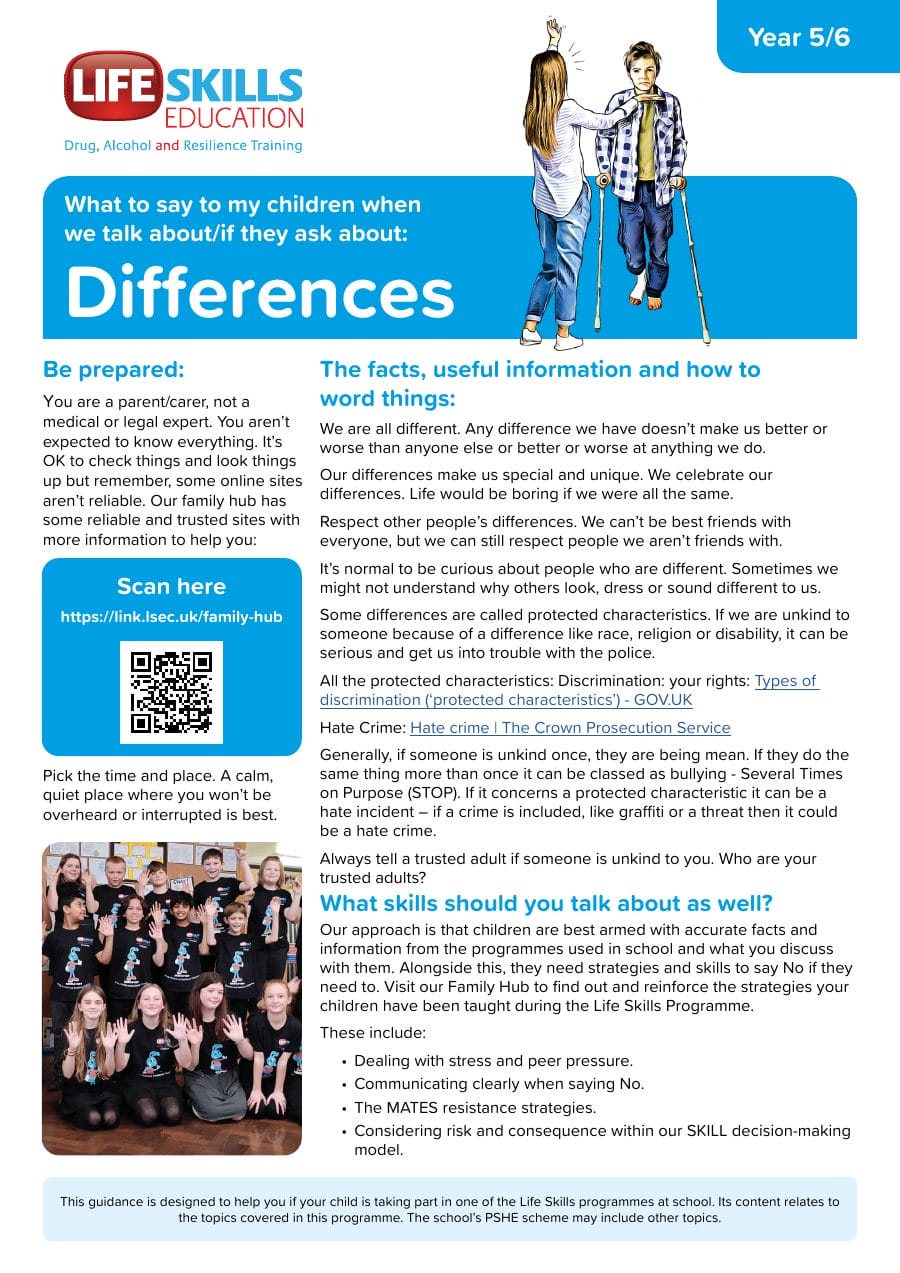
- We are all different. Any difference we have doesn’t make us better or worse than anyone else, or better or worse at anything we do.
- Our differences make us special and unique. We can’t be best friends with everyone, but we can still respect people we aren’t friends with.
- It’s normal to be curious about people who are different. Some differences are called protected characteristics, and being unkind to someone because of one, such as race, religion or disability, can get us into trouble with the police.
- Useful references: Discrimination, your rights (GOV.UK) and Hate crime (Crown Prosecution Service).
- If someone is unkind once, they are being mean. If they do the same thing more than once it can be classed as bullying, Several Times On Purpose (STOP). If it concerns a protected characteristic it can be a hate incident, and if a crime is included it could be a hate crime.
- Always tell a trusted adult if someone is unkind to you.
What skills should you talk about as well? Dealing with stress and peer pressure, communicating clearly when saying no, the MATES resistance strategies, and considering risk and consequence within the SKILL decision making model.
Online Safety
- Spending time online is not just when on a computer, but any device connected to the internet. The risks are the same.
- One way of staying safe is following age restrictions on apps, for example WhatsApp (13+ with parental consent), TikTok (13+), Snapchat (13+), YouTube (13+), Instagram (13+).
- Treat strangers online as you would in real life. Avoid accepting invitations and having conversations, and don’t give out personal information.
- Discuss options for dealing with a problem online: tell a trusted adult, block and report, use parental controls and review them regularly, take a break, or research it.
- Screen time guidance recommends one hour a day for children aged 2 to 5, and one to two hours for children aged 6 to 12.
- When online, avoid giving out personal information, even to people we know: passwords, addresses, telephone numbers, school name, parents’ names and occupations.
What skills should you talk about as well? Dealing with stress and peer pressure, communicating clearly when saying no, the MATES resistance strategies, and considering risk and consequence within the SKILL decision making model.
Solvents
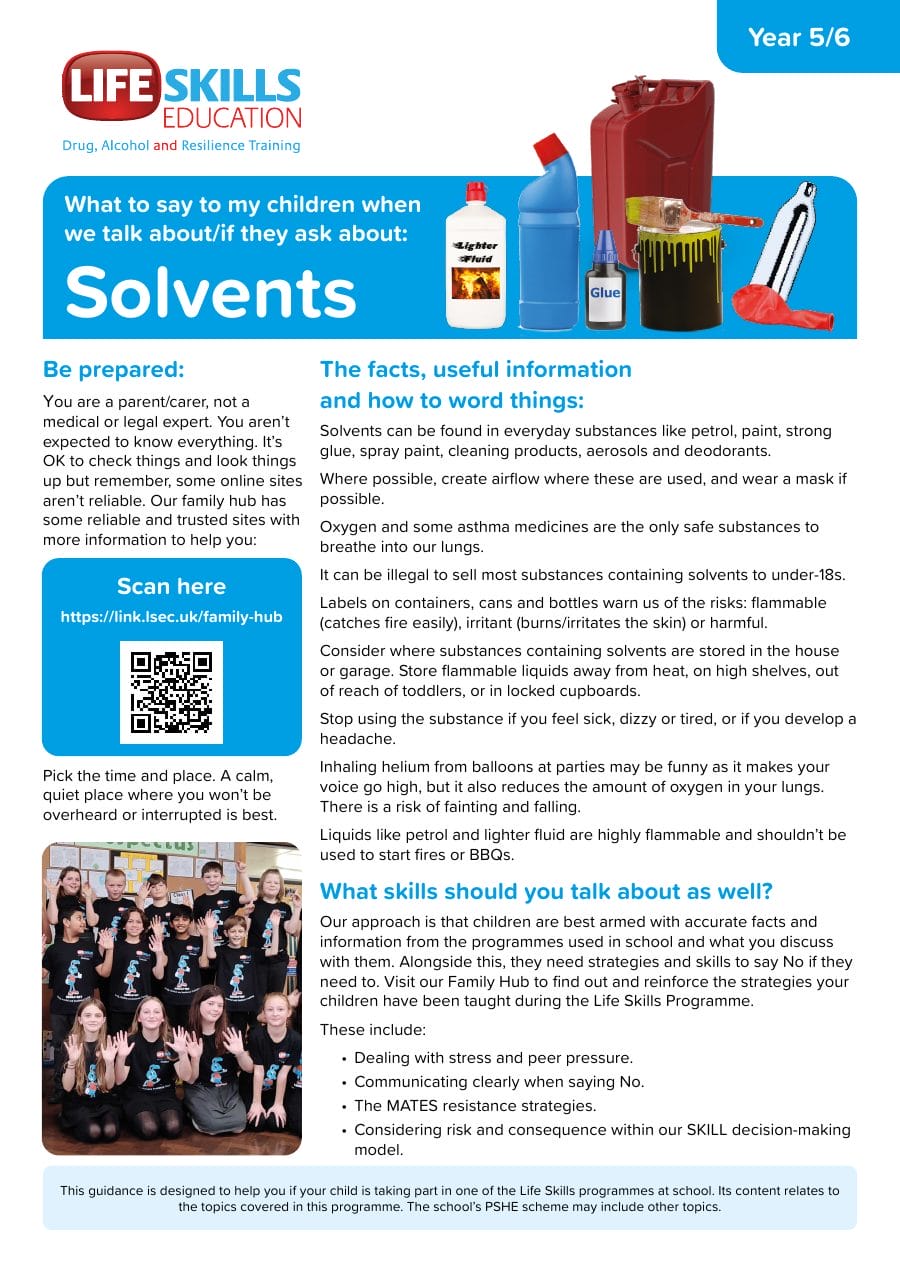
- Solvents can be found in everyday substances like petrol, paint, strong glue, spray paint, cleaning products, aerosols and deodorants.
- Where possible, create airflow where these are used, and wear a mask if possible. Oxygen and some asthma medicines are the only safe substances to breathe into our lungs.
- It can be illegal to sell most substances containing solvents to under 18s. Labels on containers warn of the risks: flammable, irritant, or harmful.
- Store flammable liquids away from heat, on high shelves, out of reach of toddlers, or in locked cupboards.
- Stop using the substance if you feel sick, dizzy or tired, or if you develop a headache.
- Inhaling helium from balloons at parties reduces the amount of oxygen in your lungs and carries a risk of fainting and falling.
What skills should you talk about as well? Dealing with stress and peer pressure, communicating clearly when saying no, the MATES resistance strategies, and considering risk and consequence within the SKILL decision making model.